
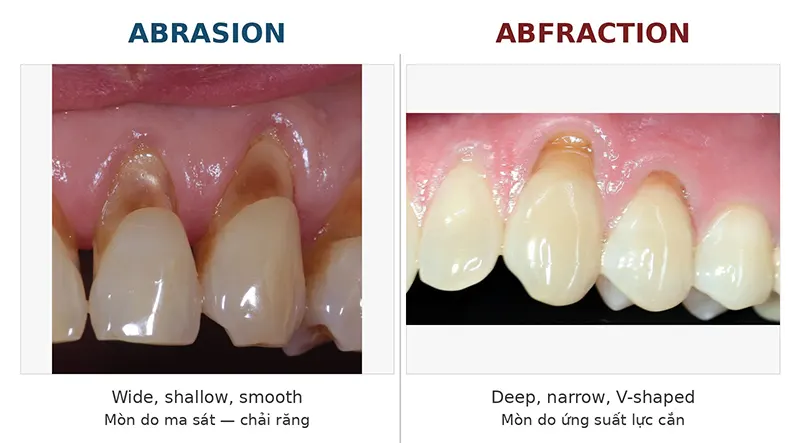
Not every cervical lesion comes from the same cause. If we only focus on filling in the lost tooth structure while ignoring the hidden force underneath, we are only treating the tip of the problem, not getting to its root.
There are 2 common mechanisms of cervical tooth wear that are often confused with each other: Abrasion (wear from friction) and Abfraction (wear from occlusal stress).
1. ABRASION: TOOTH WEAR FROM EXTERNAL FRICTION
Abrasion is simply the result of continuous mechanical forces from outside acting on the tooth surface. The most familiar culprit? Brushing too hard, brushing horizontally like “sawing wood,” or using toothpaste with too high an abrasivity.
Imagine taking a piece of sandpaper and lightly rubbing it on a wooden tabletop every day. At first, the tabletop stays perfectly flat. But after 5 years, 10 years, a clear groove will appear.
Our teeth are the same.
This is especially true at the cervical area, where the enamel is already very thin. When this enamel is repeatedly scraped away, exposing the softer dentin or cementum underneath, the rate of wear increases many times over. Abrasion lesions are usually wide and shallow, with a smooth, shiny surface.
How should Abrasion be managed correctly?
A filling has never been the first and only step.
- Eliminate the cause: Change your brushing technique (circular or vertical strokes), switch to an ultra-soft toothbrush, and choose a toothpaste with a low abrasivity index (RDA).
- Monitor or restore?
- If the wear is shallow and there is no sensitivity: no intervention is needed, just monitoring.
- If the wear is deep, causes sensitivity, or threatens the pulp, the dentist will then place a restoration.
- If you keep brushing like “sawing wood,” the natural tooth structure around the filling will continue to be scraped away. The filling will stand alone like an island and will sooner or later fall out.
2. ABFRACTION: WHEN BITE FORCE “BREAKS” THE CERVICAL AREA FROM THE INSIDE
This is very easy to mistake for friction wear, and therefore treatment often fails.
This is a completely different mechanism, much quieter and far more subtle.
Although enamel is the hardest structure in the body, it still has a certain elasticity. When subjected to very large or off-axis chewing forces, the tooth crown actually undergoes micro-flexure.
Imagine holding both ends of a plastic ruler and bending it back and forth repeatedly. The plastic will not break at the ends where your hands are holding it — it will crack right at the central bending point, where all the stress is concentrated.
Our teeth work by exactly the same biomechanical principle.
When you grind your teeth at night, or have off-axis occlusal contact points, chewing force — instead of being transmitted straight down along the long axis of the root — is converted into a lateral shearing force. All of that pressure is concentrated directly on the cervical area.
Repeated compression and tension millions of times destroys the enamel-dentin crystal bonds at the cervical area, causing these microcrystals to break apart and fall away over time. This is how sharp, deep, and narrow V-shaped cervical lesions are formed.
Managing Abfraction: why does the filling keep falling out?
If you only fill an Abfraction lesion while ignoring the bite force: every time you clench or grind, the tooth flexes microscopically again. A rigid filling bonded to a surface that is flexing will quickly develop micro-cracks in the adhesive bond and fall out.
Treating Abfraction requires a much more comprehensive approach:
- Force control: Re-evaluate the entire occlusal system and the bruxism condition.
- Check and adjust the occlusion — only when indicated: This is not for all patients with Abrasion or Abfraction. Only when occlusal interferences or traumatic occlusion are found will the dentist check the occlusion and equilibrate the full arch (occlusal equilibration) to remove interferences — spots where the bite is high or does not meet properly.
- Make a nightguard to eliminate and redistribute excess stress at night.
- Restoration: Choose a filling material with suitable elasticity so it can flex in harmony with the tooth’s deformation.
IN SUMMARY: THE CAUSE DETERMINES THE TREATMENT
In short, so it is easy to picture:
- 🔹 Abrasion (from external force — the toothbrush): The wear is usually wide and smooth. The key to treatment is changing the toothbrush and fixing the brushing technique before thinking about a filling.
- 🔹 Abfraction (from internal force — the bite): The wear is usually deep and sharply V-shaped. The key to treatment is adjusting the bite force, correcting the occlusion when indicated, and wearing a nightguard — not just placing a filling and calling it done.
In clinical reality, it is even more complex, because a single tooth can be affected by both of these mechanisms (plus acid erosion) at the same time.
Quick comparison
| Abrasion | Abfraction | |
|---|---|---|
| Cause | External friction: brushing too hard, brushing horizontally, high-RDA toothpaste | Occlusal stress: teeth grinding, off-axis occlusion |
| Lesion shape | Wide, shallow, smooth surface | V-shaped, sharp, deep and narrow |
| Key treatment | Ultra-soft toothbrush, correct brushing technique, low-RDA toothpaste — then a filling only if needed | Check / adjust the occlusion only when indicated, nightguard, filling material with suitable elasticity |
| Why a filling can fail | Tooth structure around the filling keeps being worn away | Micro-flexure of the tooth cracks the adhesive bond of the filling |